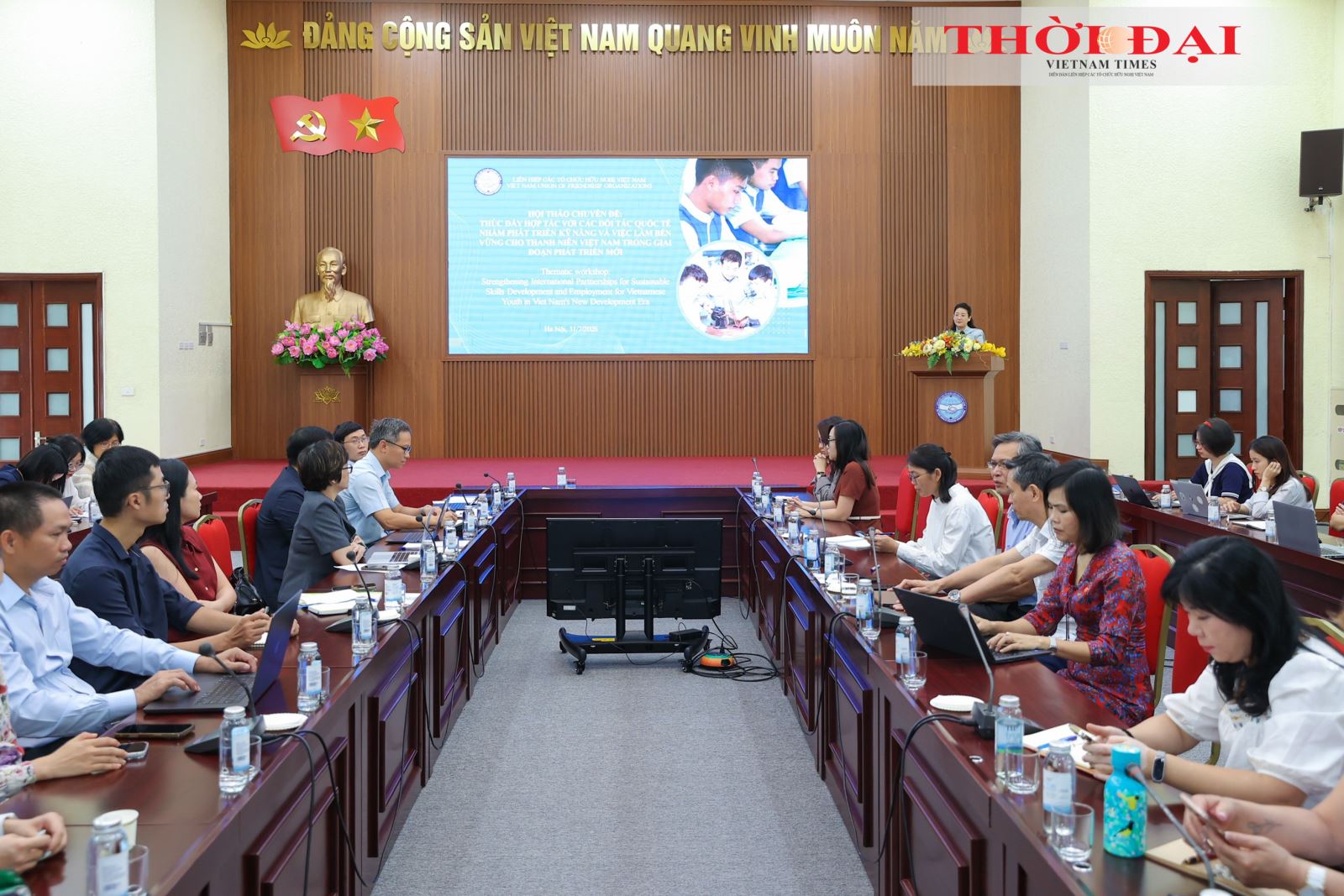
On July 28 in Hanoi, the Viet Nam Union of Friendship Organizations hosted the thematic seminar “Digital transformation in agriculture in Viet Nam: Strengthening multi-stakeholder cooperation for sustainable development.” The event brought together representatives of government agencies, international organizations, foreign non-governmental organizations, businesses, and local authorities to exchange perspectives, share experiences, and propose solutions to advance digital transformation in the agricultural sector.
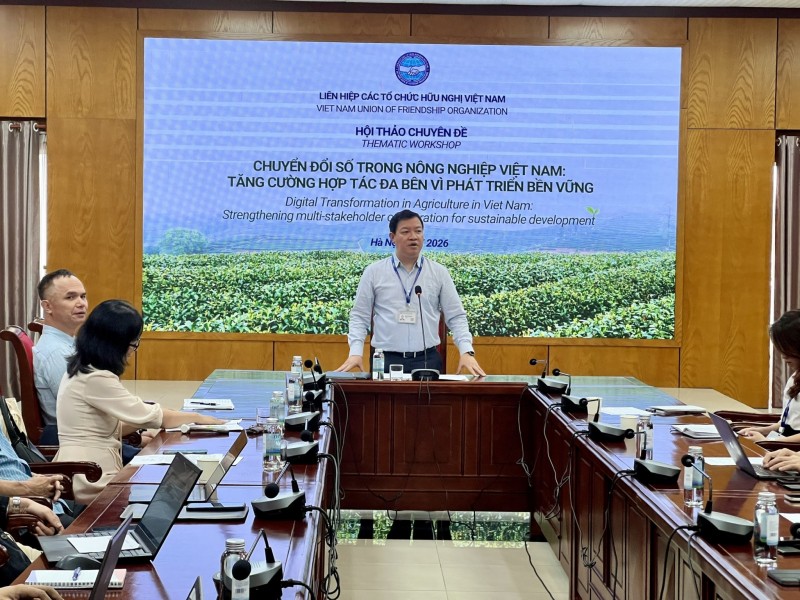 |
| Nguyen Ngoc Hung, Vice President of the Viet Nam Union of Friendship Organizations, delivers the opening remarks. (Photo: Mai Anh) |
In his opening remarks, Nguyen Ngoc Hung, Vice President of the Vietnam Union of Friendship Organizations, noted that although agriculture's share of Viet Nam's GDP has declined over the years, the sector remains a cornerstone of the economy, playing a vital role in ensuring food security and promoting sustainable development. In the current context, digital transformation not only improves productivity and product quality but also encourages people to remain engaged in agriculture, enhances the value of regional specialty products, and expands access to both domestic and international markets.
Nguyen Ngoc Hung also highly appreciated the contributions of foreign non-governmental organizations to agricultural development in Viet Nam. According to statistics, around 60 organizations are currently implementing projects in this field, with total annual aid amounting to approximately USD 45-50 million over the past five years. Beyond providing financial resources, these organizations also share expertise, introduce successful models, and foster international partnerships, thereby contributing to innovation in agriculture.
Digital transformation is an inevitable requirement
Presenting the keynote report at the seminar, Vu Ngoc Tuan, Deputy Head of the Digital Technology Division under the Digital Transformation Department of the Ministry of Agriculture and Environment, observed that the agricultural sector is simultaneously facing multiple challenges, including increasingly severe climate change, disruptions to global supply chains, and the need to renew its growth model.
Export markets are also imposing increasingly stringent requirements regarding product quality, traceability, and information transparency. In this context, the application of science, technology, and digital transformation is no longer an option but has become a prerequisite for enhancing the competitiveness of Vietnamese agricultural products.
According to Vu Ngoc Tuan, the Ministry of Agriculture and Environment is gradually shifting from a fragmented governance model to one based on digital data. The Ministry has developed a digital architecture framework and a data governance framework, divided its data space into 27 domains, and issued 19 technical regulations for sector-specific databases. At the same time, the Ministry's traceability system has been piloted since July 2026, initially covering the export durian supply chain before being expanded to other key agricultural products.
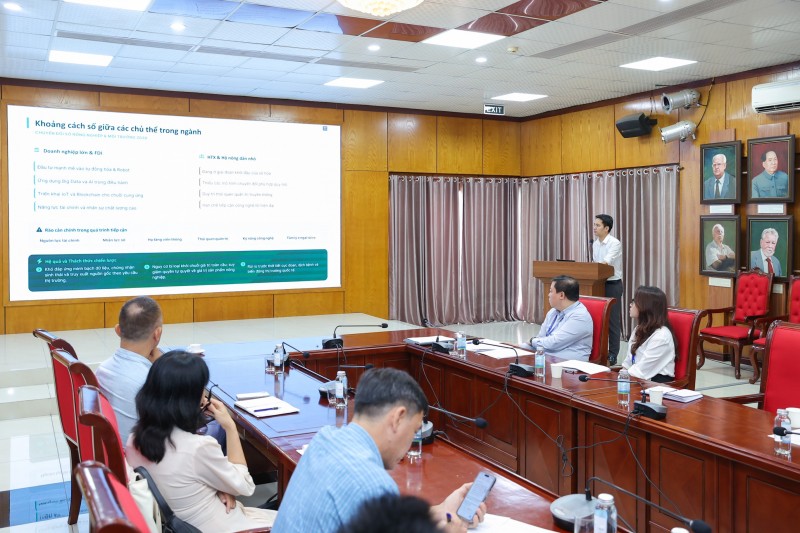 |
| Vu Ngoc Tuan, Deputy Head of the Digital Technology Division under the Digital Transformation Department of the Ministry of Agriculture and Environment, presents the keynote report. (Photo: Dinh Hoa) |
However, the digital transformation process continues to face numerous obstacles, including fragmented data, inconsistent technologies, disparities in infrastructure among localities, and, in particular, the digital divide between large enterprises and cooperatives and farming households.
“The scale and complexity of the digital revolution in agriculture have exceeded the capacity of any single stakeholder,” Vu Ngoc Tuan emphasized. He stressed the need to establish a multi-stakeholder cooperation alliance involving the government, businesses, research institutions, international organizations, and farmers to mobilize resources, share knowledge, and drive innovation.
International cooperation drives innovation
Sharing experiences from the Aus4Innovation Program, Nguyen Thi Huong Thao, Program Manager of Aus4Innovation at Australia's Commonwealth Scientific and Industrial Research Organisation (CSIRO), said the program is focusing on supporting digital transformation solutions for sustainable agriculture and climate change adaptation.
According to Huong Thao, technologies such as artificial intelligence (AI), the Internet of Things (IoT), satellite imagery, robotics, data platforms, and digital twins have been applied in various projects to improve crop productivity, reduce emissions, enhance traceability, and support data-driven decision-making. These solutions not only improve production efficiency but also expand farmers' access to markets.
“Innovation is not about bringing technology from overseas into Viet Nam. It must be a process of co-development between international and Vietnamese partners, with farmers involved from the very beginning,” Nguyen Thi Huong Thao said.
She also emphasized that, rather than pursuing one-way technology transfer, greater attention should be given to strengthening the capacity of local partners to ensure that project models can be replicated and sustained after project completion.
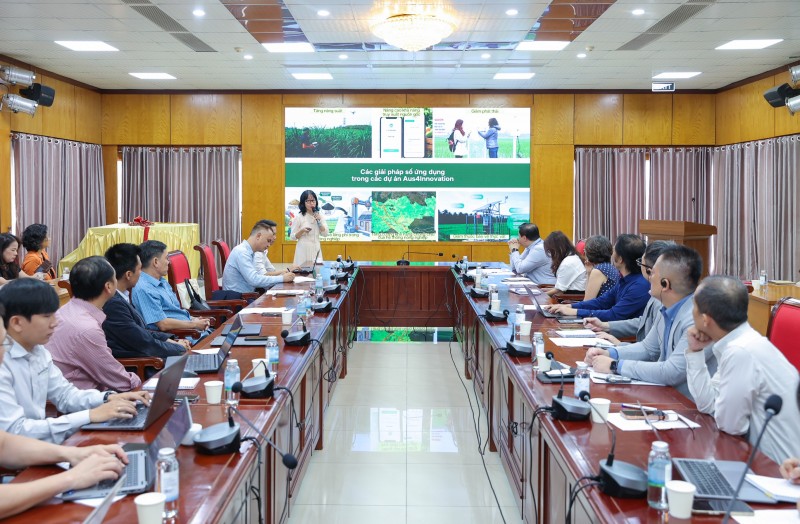 |
| Nguyen Thi Huong Thao, Program Manager of Aus4Innovation at Australia's Commonwealth Scientific and Industrial Research Organisation (CSIRO), presents her remarks at the seminar. (Photo: Dinh Hoa) |
Representatives of HELVETAS Viet Nam also shared practical experience in digitalizing agricultural value chains through projects involving tea, spices, cocoa, and pepper. They stressed that digitalization should be viewed as a tool for promoting green agriculture and the circular economy, rather than an end in itself.
According to HELVETAS Viet Nam, data should serve as the foundation of digital transformation. Implementation should proceed in phases, prioritizing the most pressing needs before scaling up. Farmers should also be involved from the design stage to ensure that digital solutions are well aligned with production realities.
From a local perspective, Duong Son Ha, Deputy Director of the Department of Agriculture and Environment of Thai Nguyen Province, said the province is accelerating the development of agricultural databases, digital maps of cultivation areas, traceability systems, and the listing of One Commune One Product (OCOP) products on e-commerce platforms.
For tea - the province's flagship agricultural product - Thai Nguyen aims to generate approximately VND 25 trillion in revenue by 2030. By that time, 70% of the province's tea-growing area is expected to be assigned cultivation area codes and meet quality standards for export. However, the province continues to face challenges, including limited funding to maintain digital infrastructure, a shortage of information technology personnel, and the growing migration of young workers away from the agricultural sector.
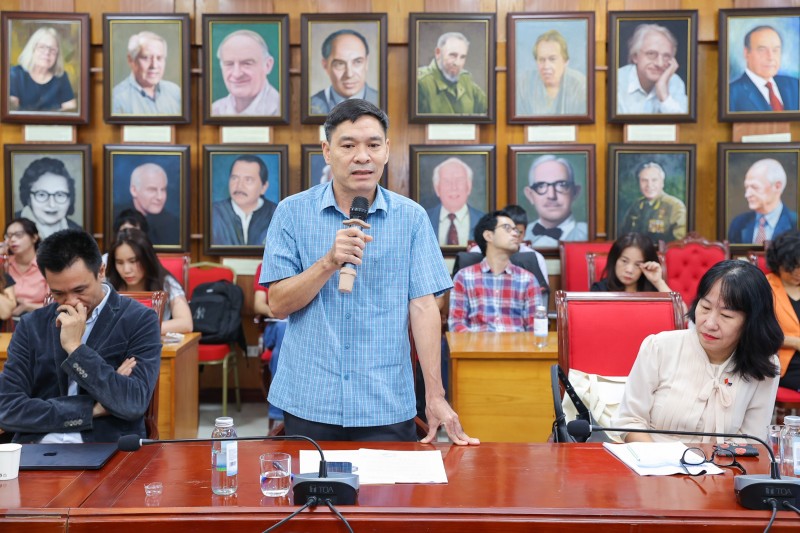 |
| Delegates engage in discussions at the seminar. (Photo: Dinh Hoa) |
At the seminar, participants agreed that digital transformation in agriculture is not merely about adopting new technologies but represents a comprehensive transformation in governance, production methods, and market connectivity. Building a smart, transparent, and sustainable agricultural sector will require continued promotion of multi-stakeholder cooperation and the effective mobilization of resources from the government, businesses, international organizations, research institutions, and farmers to jointly develop a digital agriculture ecosystem for the new era.
Source: Vietnamtimes