

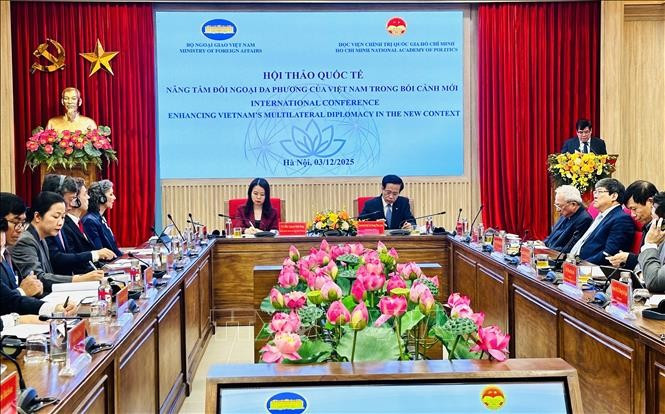
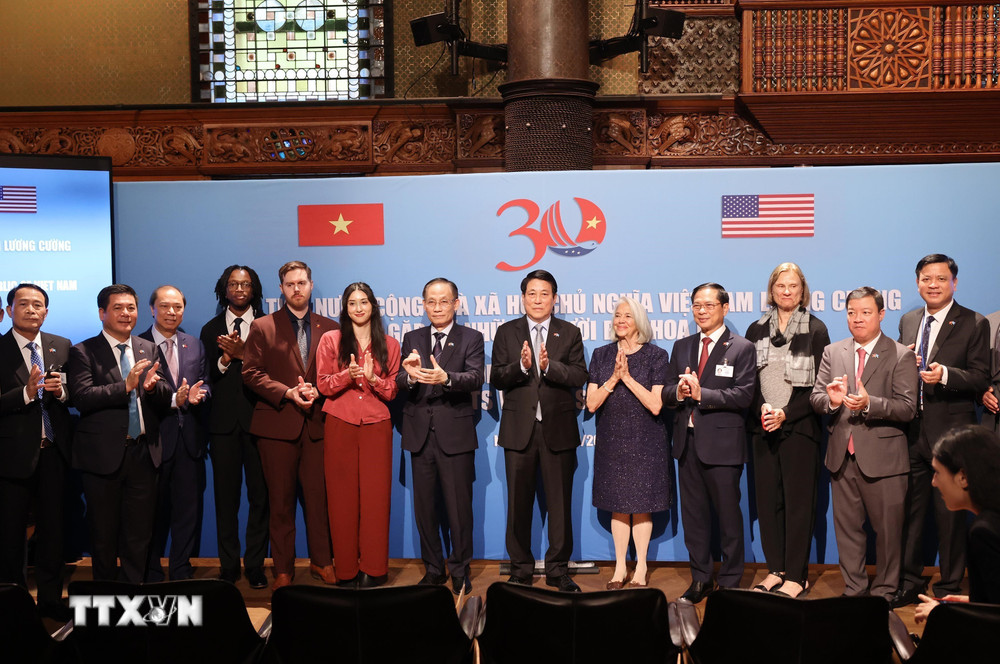
Overview of the seminar (Photo: VNA)
Amid new opportunities and challenges, Viet Nam is determined to further promote its role in multilateral mechanisms, and actively contribute to shaping a shared future of peace, cooperation, and sustainable development, stated Hoang Phuc Lam, Vice President of the Ho Chi Minh National Academy of Politics.
Addressing the opening of an international seminar on strengthening Viet Nam’s multilateral diplomacy in the new global context, Lam said shifting geopolitical, economic, technological and environmental dynamics are transforming both the interactions among states and the norms of international cooperation. In this environment, he noted, multilateral diplomacy has become an important pillar where countries find common ground, share responsibilities and forge sustainable responses to global challenges.
Lam underlined that multilateral diplomacy remains the cornerstone of Viet Nam’s foreign policy. The 13th National Party Congress reaffirmed the priority of “promoting and elevating multilateral diplomacy,” calling for Viet Nam to take a more active role in shaping regional and global institutions, particularly within ASEAN and the United Nations.
During more than 30 years of integration, multilateral diplomacy has played a crucial role in maintaining a peaceful and stable environment for development, enhancing Viet Nam’s international profile, expanding external relations, and attracting investment, technology, and resources. It has also supported the country’s engagement with major powers and contributed to the strategy of safeguarding the country from early and afar.
Looking ahead, Lam said Viet Nam needs fresh ideas about the role, scope, and content of multilateralism, better skills in strategic forecasting and institution building, and greater investment in people for multilateral work. Viet Nam should take a more active part in new cooperation frameworks on technology, the environment, digital data, artificial intelligence (AI), maritime issues, and water security, while making the most of both domestic strengths and global partnerships.
Deputy Foreign Minister Nguyen Minh Hang reiterated that multilateral diplomacy is essential to defending independence and sovereignty and driving national development. Viet Nam, she affirmed, is committed to deepening cooperation with partners, engaging in shaping multilateral institutions and mobilising external resources in support of domestic priorities, contributing to a rules-based international order built on equality and mutual respect.
The seminar reviewed progress in implementing the multilateral diplomacy strategy set by the 13th National Party Congress and discussed breakthrough measures to advance Viet Nam’s multilateral engagement in the next phase of development.
Experts and scholars highlighted the lasting relevance of the Ho Chi Minh diplomatic doctrine, anchored in “independence and self-reliance” and “steadfast principles with flexible application”, as a guiding foundation for Viet Nam’s modern multilateral diplomacy, ensuring both national sovereignty and effective international integration.
Participants also examined evolving geopolitical shifts, major-power competition, the Fourth Industrial Revolution, and fast-changing security challenges, as well as the rise of new multilateral structures. They agreed that these trends offer opportunities for Viet Nam to play a more proactive and creative role through institutional strengthening, high-quality human resource development, enhanced strategic research and forecasting, and stronger economic, cultural and digital diplomacy.
Representatives of foreign missions expressed readiness to support Viet Nam and commended its increasingly active and responsible contributions to global affairs./.
Source: VNA
.jpg)

(1).jpg)
.jpg)